COMPANY & PORTFOLIO · CLASSIC PRODUCT IP · KNOWLEDGE GRAPH FOR AI · LICENSE ONLY

InfoLibrarian™ Enterprise Metadata and Knowledge Graph Platform

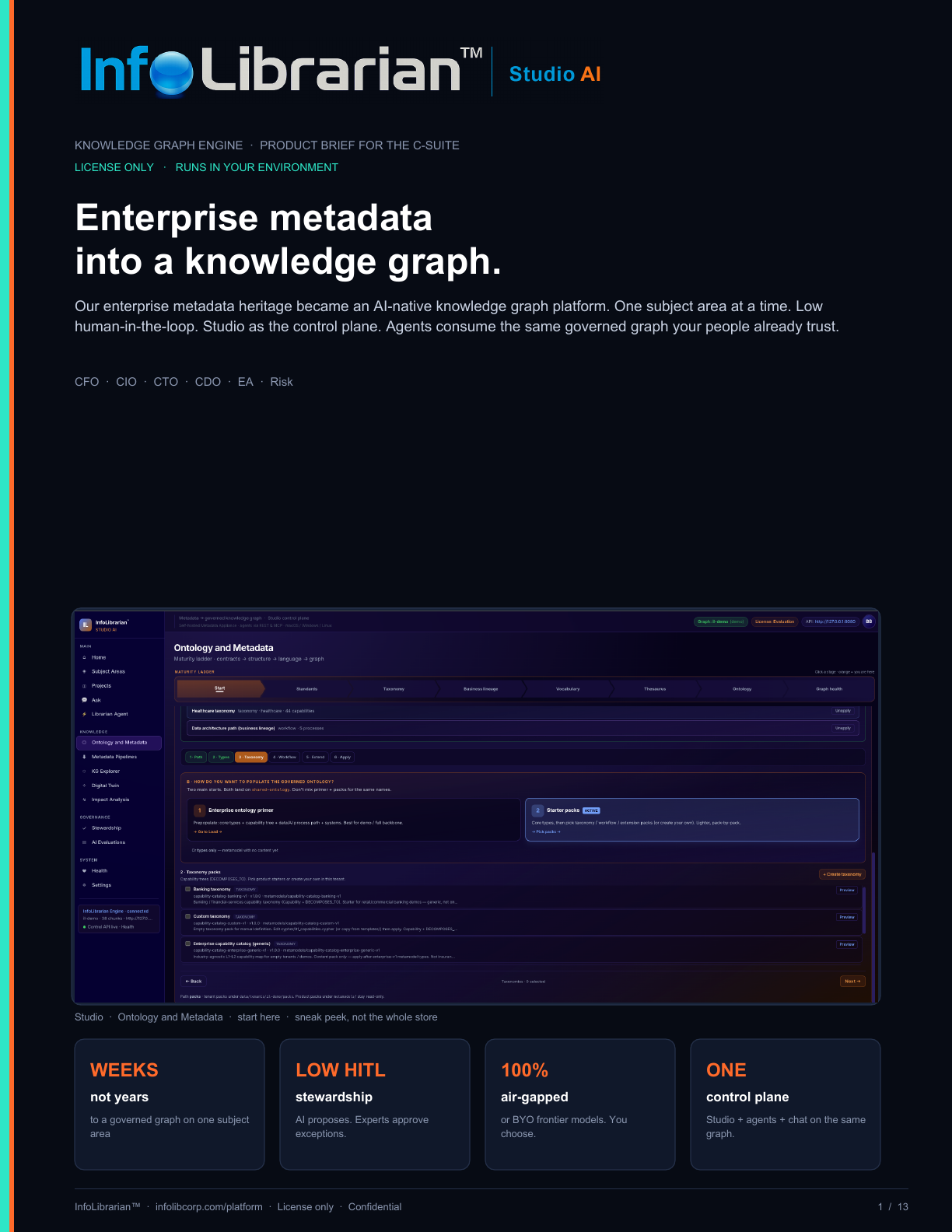
Enterprise metadata into a knowledge graph.

Enterprise metadata feeds a governed knowledge graph so people and agents get connected context. What began as the Metadata Appliance is this platform.

Powered by the Knowledge Graph Engine. Runs in your environment.

View the portfolio → Inside the engine →


From Chaos to Trusted Context

Four movements, one governed knowledge graph. Each stage earns trust in the next, so the answer at the end can be believed.

01 CAPTURE02 CONNECT03 ACTIVATE04 TRUST
01 · CAPTURE

Wrangle the Mess

Legacy and modern formats, embedded tables and diagrams, duplicates, decisions that were only ever spoken. The Knowledge Graph Engine reads the meaning others flatten to plain text and throw away.

02 · CONNECT

Build the Knowledge Graph

Enterprise metadata and applications become one connected, governed graph, one subject area at a time, so quality compounds instead of drowning in noise.

03 · ACTIVATE

Ground the Agents

Answers to the questions that span systems, not chunks. Delivered to your people, your applications, and your agents, through open interfaces.

04 · TRUST

Prove the Answers

Every answer traces to its source. Every answer is scored. Trust becomes a number you can show a regulator, not a promise you have to make.


The Questions It Was Built to Answer

The questions that actually decide architecture and risk are never in one document. They live in the relationships between them, which is exactly what flat search cannot see.

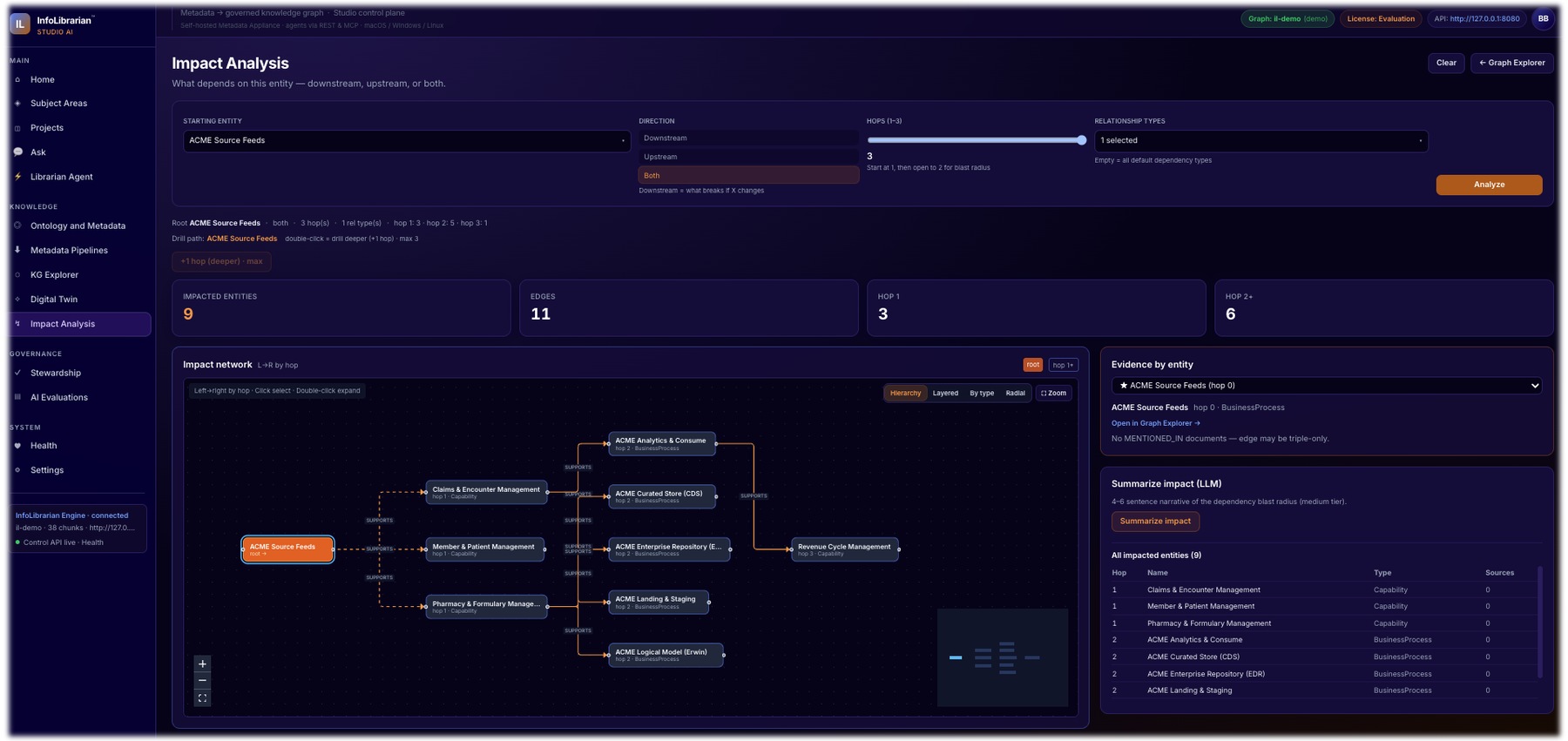
  • What breaks downstream if this system fails? Impact analysis across everything that depends on it.
  • Which parts of the business share this data? The connections nobody documented but everyone assumed.
  • Where does this business term actually live? From the word a person uses to the systems that implement it.
  • What do we already know about this? The answer that was in the corpus the whole time, that no one could find.
What breaks if this fails?MODELSYSTEMREPORTPROCESSSOURCED
If a business user reads the answer and says yes, that is right, and I could not have found that myself in under an hour, the system has done its job.

What you get

Enterprise metadata into a governed graph people and agents can use.

The graph

Robust Ingestion

Rips sources rather than flattening them. Structures, models, and content keep their shape; diagrams keep their connections; spoken decisions become searchable knowledge.

A Governed Knowledge Graph

Your business language, modeled once and applied everywhere, so meaning stays consistent across every domain and every source.

Impact Analysis and Traceability

Follow any dependency across the enterprise, and see the exact path behind every answer. Explainable by construction.

Automatic Gap Closing

The relationships that are true but were never written down get discovered, proposed for review, and approved by your experts before anything is trusted.

The answers

Tunable Retrieval

Dial from fully deterministic to hybrid, so you choose exactly how much the system reasons versus how much it sticks to what it retrieved.

Measured Trust

Every answer scored on faithfulness, relevancy, precision and recall. Quality is a number you can report, not a claim you have to defend.

Built for Agents

Open interfaces mean the Knowledge Graph Engine becomes the trusted context layer your agents call, not one more application to log into.

Start Small, Compound Fast

Prove value on one high-value subject area in weeks. Add the next with confidence, because each domain makes the whole graph smarter.


From Vocabulary to a Governed Graph

A subject area does not become a knowledge graph in one step. It matures through stages, each one reviewed and approved by your people before the next begins. This is the sequence InfoLibrarian has refined since 2005, now run in your environment, one subject area at a time.

STAGE 1
Controlled Vocabulary

Agree the terms. Synonyms and duplicates resolved, so one concept carries one name.

STAGE 2
Metadata Schema

Each term gets structure and a canonical identity, so the same thing is never counted twice.

STAGE 3
Taxonomy & Thesaurus

Terms organised into hierarchies and related-term links that mirror how the business thinks.

STAGE 4
Governed Ontology

The model of your domain: types, relationships, rules. Proposed by the system, approved by your experts before it is trusted.

STAGE 5
Knowledge Graph

The connected, queryable result your agents reason over, every fact traceable to its source.

Nothing skips review. Full-corpus, hands-off ontology is a trap that collapses into noise. The platform keeps the work scoped to one subject area at a time, iterative, and human-approved, on your metadata and content.


One package, three sizes

The platform ships as a ready-to-run package (VM or container), not a box on a loading dock. You size the environment; the same software runs on pilot, production, and enterprise tiers. Built on proven InfoLibrarian software and modern local AI.

READY-TO-RUN PACKAGEYOUR ENVIRONMENTAIS · PilotM · ProductionL · Enterprise
One package, three tiers. You size the environment; the software runs the same on all three.
S
Pilot
  • One subject area
  • Apple Silicon or RTX 4080/5080 class
  • Single user, proof of concept
M
Production
  • Single or few domains
  • RTX 5090 class
  • Small team, dedicated inference
L
Enterprise
  • Enterprise, multi-domain
  • A100 / H100 class
  • Department scale, full parallel

The world's first Metadata Appliance. Now a knowledge graph platform.

In 2005 InfoLibrarian shipped the world's first metadata integration appliance. Today that line continues as a knowledge graph platform: governed meaning, relationships as first-class objects, impact analysis, and business language mapped to systems: the design goals of the platform we shipped into Fortune 100 environments from 2005. The industry spent two decades catching up to that vision. This is what it looks like now that the technology finally can.

InfoLibrarian Metadata Integration Appliance, 2005 — the world's first
The original InfoLibrarian Metadata Integration Appliance, 2005. The world's first.
KNOWLEDGE GRAPHAGENTS
Today: a governed knowledge graph grounding agents.
2005 · RACK UNIT

Semantic layers and metadata knowledge graphs, on the technology of the day.

2015 · CLOUD IMAGE

The same appliance as a turnkey image on the Azure Marketplace. Microsoft published the datasheet. Windows patching eventually outran the return.

2026 · PLATFORM

The same vision on graph databases, local AI, and agent-native interfaces. Runs in your environment.


Runs in your environment

The same stack runs in your environment or your cloud. Your metadata, content, and answers stay under your control, with no requirement to send them to a third-party model host.

Bring your own AI models and LLMs. Use models you already approve and run where you run them (Anthropic, OpenAI, Hugging Face, Ollama, Azure OpenAI, private and on-prem endpoints, and other approved hosts). The platform grounds those models in your governed knowledge graph; it does not lock you into a single vendor model or a mandatory hosted inference bill.

For highly regulated environments

Air-gapped capable.

Run fully offline when policy requires it: metadata, content, graph, and inference stay inside your boundary. Same platform as connected deployments, without data leaving the building.

Platform and Knowledge Graph Engine are InfoLibrarian commercial IP, available by license.