
InfoLibrarian™ · Knowledge platform framework
Meaning as a first-class platform capability.
Enterprise metadata management is the foundation: metamodel, vocabulary, mappings, lineage, and the path to a knowledge graph. This is the design system behind the portfolio and the licensed platform: not a second product store.
Platform → Portfolio → Heritage →
Capability model → · Classic building blocks → · EMM →
Enterprise meaning capability model
Primary view for how meaning stacks: language and models on the metamodel, connected to applications and physical systems, without replacing systems of record. Capability diagram first; detail cards below.
Enterprise capability view: consume → language → business models on metamodel → connect → physical
Shared definitions of business terms and owners
Governed term sets for consistent naming and classification
Hierarchical domain structures for navigation and classification
Preferred terms, synonyms, broader/narrower relationships
Flexible steward or community tags, still under governance
Typed concepts and relationship rules for domain semantics. Business-level, sitting on the metamodel alongside business models.
Sit on the metamodel: capabilities, value streams, products, processes, domains, subject areas
Where you start: entity and relationship types, expressed as a property graph
Instances of meaning on the metamodel — entities and relationships as first-class objects. A property graph is the knowledge graph.
Concept → logical → physical (terms, models, schemas, tables, fields, systems)
Dependencies and change impact across the estate
Adapters and APIs that expose meaning to applications and portals
Search, discovery, and self-service for business and technical users
Heritage diagram · classic product era
Classic metadata management building blocks
How the discipline was published when it ran as licensed product software: technical, business, and enterprise metadata feeding search, impact, lineage, and publishing. Same concerns, modern substrate on the Platform path above.
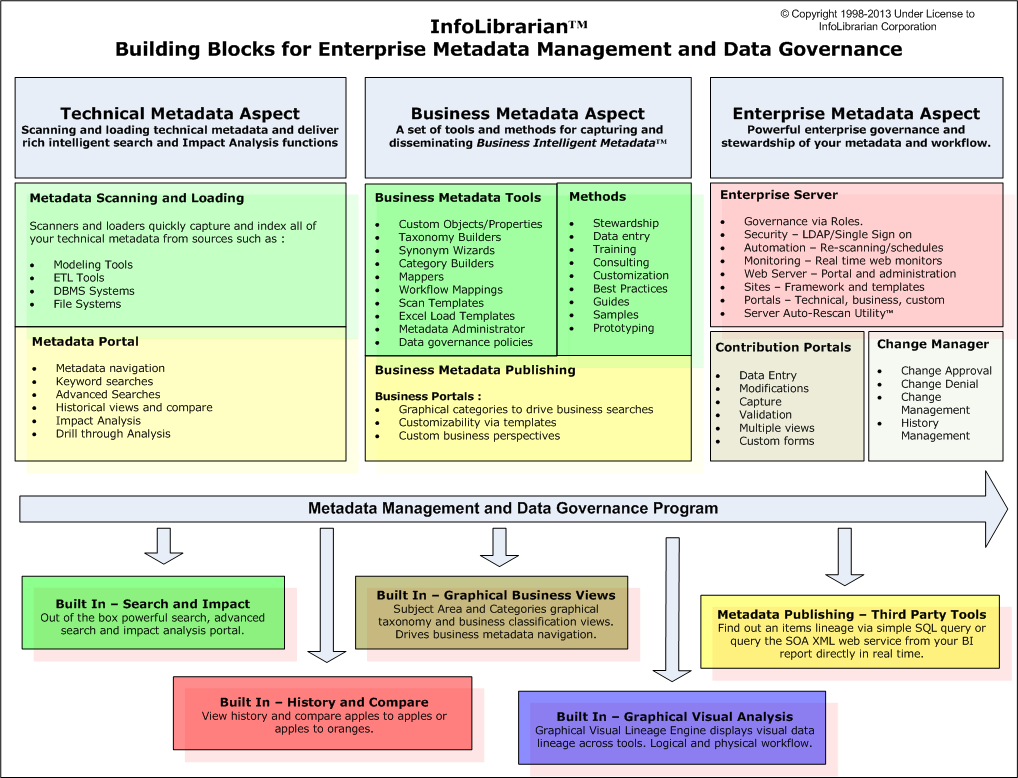
Classic product framework. Building blocks for enterprise metadata management and data governance — as published for the licensed platform. Open full size →
Enterprise Metadata Management
EMM is where you start: design the metamodel, then capture, connect, and activate meaning across the estate. That foundation powered scalable programs and is more critical now for AI, semantic layers, and knowledge graphs than when it was first proven.
Where EMM goes next · Platform IP
Same discipline. Modern substrate. Licensed under InfoLibrarian.
Everything above was proven inside enterprises under licence. The method did not change; the substrate did—graph databases, local AI, agent-native interfaces. Next-generation work continues as InfoLibrarian Platform IP (including Knowledge Graph Engine), commercial intellectual property available by license.