
InfoLibrarian™ · Portfolio
Portfolio outcomes. Enterprise proof.
Case notes from InfoLibrarian enterprise metadata software and programs—finance, healthcare, media, travel, and more. The portfolio record behind the company and software IP: vocabularies, lineage and impact, glossary-driven context, and large-estate delivery.
Portfolio KPIs
Formal proof layered in: press (BMO), case PDFs (Fujifilm, University of Arizona), awards context (Wilshire), Microsoft Azure ISV collateral, classic appliances, and the framework record.
The portfolio · hover to pause
Explore by sector
Results at a glance
Named outcomes from production programs across the portfolio.
Across production implementations. Roughly 40% faster data discovery, 25% faster platform launches and project timelines cut by 30%. Typical outcomes estimated across deployed accounts, not a single engagement.
About These Engagements
This portfolio highlights architecture-led work that delivered measurable results across industries, grounded in the framework.
Learn about the Knowledge Platform Framework →
Media & Entertainment

A&E Television Networks (AETN)
Metadata Contracts for Netflix Syndication
FIMS-compliant · 20 EDAM systems unified
Challenge: A&E needed to syndicate content to Netflix, which meant metadata from 20 separate EDAM systems had to be canonicalized, made FIMS compliant, and reconciled into unified taxonomies across every AETN brand and DAM asset library.
Solution: InfoLibrarian integrated and mapped the metadata sources, built an A&E and FIMS-compliant enterprise metadata model, and automated taxonomy standardization so real-time data contracts could drive Netflix B2B distribution.
Results:
- Canonicalized taxonomies across AETN brands and DAM content assets
- FIMS-compliant metadata exchange with Netflix B2B syndication systems
- 20+ EDAM sources and industry metadata platforms unified
- 80% reduction in manual metadata effort through data contract automation
“InfoLibrarian transformed our metadata strategy, streamlining processes, ensuring compliance, and supporting seamless syndication to Netflix streaming. The solution was scalable, efficient, and delivered on our goals.”
— AETN Project Sponsor, A&E Television Networks
Financial Services



BMO Financial Group
Chosen by an Award-Winning Metadata Program
Evaluated 2006 · In production 2007 · Under support through 2018
Challenge: BMO had built one of the strongest enterprise metadata programs in banking, led by a dedicated Metadata Architect since 2000. In 2006 that program won the Wilshire Conferences Award for Metadata Best Practices, judges citing executive support, a well thought out architecture, and an impressive scope of implementation. That same year the bank went to market for a platform capable of carrying a program of that maturity across global operations and regulatory demands including Basel II and AML.
Solution: BMO issued a formal metadata RFP in October 2006 and ran an on-site evaluation alongside it. InfoLibrarian software was selected and moved into production in 2007. The program ran for the next decade: portal and QA server licensing, universal XML scanning against staging systems, taxonomy work, product enhancements, professional services in 2013, and a vendor security assessment in 2014. Maintenance renewed annually through 2017.
Results:
- Selected through formal RFP by a team whose program won the 2006 Wilshire Award
- Evaluated in 2006, in production 2007, in service through 2018
- Unified metadata across global operations
- Supported Basel II and AML regulatory requirements
- Automated scanning and lifecycle workflows
- Passed enterprise vendor security assessment
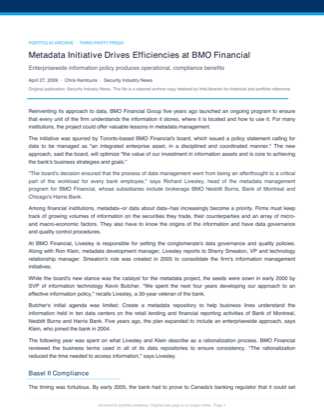
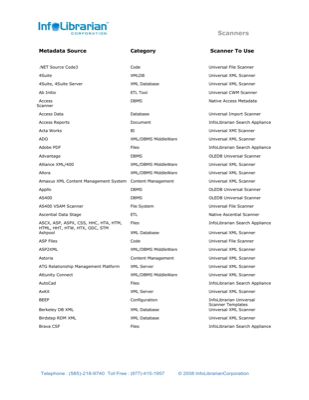
The Wilshire award recognized BMO’s own program. Ron Klein, team leader for the bank’s enterprise metadata initiatives, and Wayne Harrison, Metadata Architect, built it. InfoLibrarian was the platform they evaluated and chose to run it on. In April 2009, Security Industry News (Chris Kentouris) covered the bank’s metadata initiative and the move to InfoLibrarian’s framework. That article is no longer on the publisher’s site; we retain an archived copy as evidence of the engagement.
“We set out to solve a metadata problem and ended up transforming our entire approach to data governance. We consolidated fragmented repositories, standardized business definitions, and dramatically improved the traceability of critical information. The flexibility of the platform allowed us to meet regulatory requirements with confidence, while also empowering hundreds of users in technology, marketing, and risk. What we have now is more than metadata — it’s a trusted source of truth that fuels strategic decision-making and operational agility.”
— Head of Data Governance, BMO Financial Group

Standard & Poor's (S&P)
Vendor Selection Run as an Engineering Exercise
Structured RFI · Multidimensional scoring
Challenge: Metadata silos blocked governance standardization and discoverability across a diverse platform estate built on Oracle, Informatica, ERwin and Trillium — while large integration programs, including Compustat and Research Insight, depended on getting control of data items, applications and processes.
Solution: Under an InfoLibrarian program, S&P ran a structured RFI and vendor selection aligned to enterprise architecture: requirements workshops, a custom RFI with multidimensional scoring, facilitated demos and proofs of concept, then a final platform recommendation and implementation roadmap, with InfoLibrarian software and methods in the frame.
Results:
- Custom RFI and multidimensional scoring model built for the selection
- Vendor demos and proofs of concept facilitated end to end
- Insight and control over data items, applications and processes driving the Compustat and Research Insight programs
- Platform selected against long-term enterprise standards
- Unified metadata interface established for consistent governance
- 15–20% gain in analytics productivity, with 20% improvement in BI access
“We were able to get about 80% of what we needed done very quickly; in fact the scanning was completely automatic. InfoLibrarian is a powerful product. We are very impressed!”
— Enterprise Architecture Sponsor, Standard & Poor’s
“The metadata integration provided by InfoLibrarian gave our teams the confidence to use and trust the data they had.”
— Enterprise Data Leadership, Standard & Poor’s
Fidelity Investments
A 120-Hour Proof of Concept, Then the Enterprise
Engaged 2013 · 120-hour PoC
Challenge: Documentation gaps, metadata redundancy and high-cost manual governance workarounds across the enterprise.
Solution: A 120-hour proof of concept and internal risk assessment preceded delivery of a centralized metadata clearing house and documentation portal. The engagement was built for enterprise ownership: no licensing or maintenance fees on customizations, 100% open metadata access, and tailored training with knowledge transfer embedded in delivery.
Results:
- 120-hour PoC and formal internal risk assessment before commitment
- Open framework with no licensing or maintenance fees on customizations
- 100% open metadata access, no vendor gatekeeping
- Glossaries, classifications and quality metrics on one platform
- Reduced vendor dependency and accelerated governance maturity
“InfoLibrarian enabled Fidelity to take control of our metadata landscape and governance practices, while transferring essential knowledge to our internal team. The framework is both open and adaptable — exactly what a modern enterprise needs.”
— Enterprise Architecture Team, Fidelity Investments
Government & Education






University of Arizona
Enterprise Metadata Service for a Fragmented Campus Estate
Proof of concept 2005 · In production from 2006
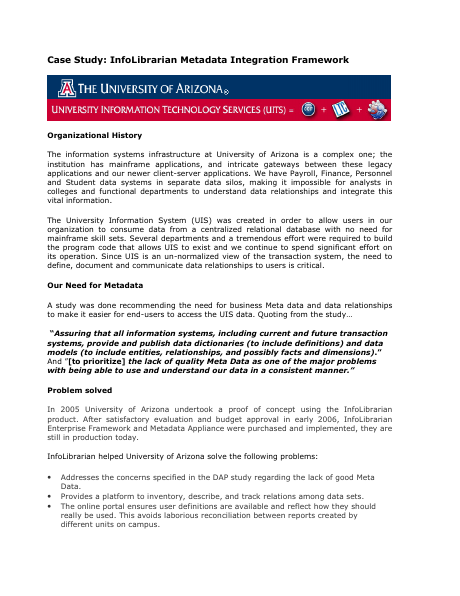
Challenge: Payroll, Finance, Personnel and Student data sat in separate silos, with intricate gateways between mainframe and client-server applications. The University Information System gave analysts a central relational database, but as an un-normalized view of the transaction system it left them unable to see how data related. An internal study named the lack of quality metadata as one of the major barriers to using university data consistently.
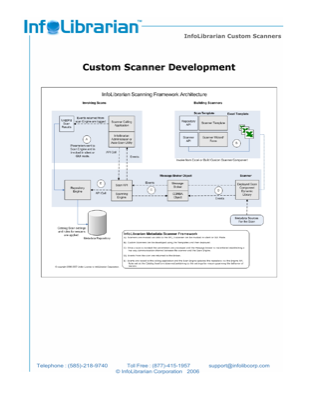
Solution: A proof of concept in 2005, then budget approval and production implementation in 2006 of InfoLibrarian Enterprise — metadata software plus the Metadata Integration Appliance. Portal, Scanning, Administrator, Framework and templates, with training and support. A custom scanner for the university’s DEC/Oracle RDB automated publishing of technical metadata to the portal, and Excel API templates let subject matter experts contribute in a tool they already knew.
Results:
- In production from 2006, still running at the time of the case study
- Automated metadata publishing via a custom DEC/Oracle RDB scanner
- Subject-area organization so analysts could see where data lived and how it related
- Portal customizations preserved across product upgrades
- Enterprise-wide metadata service delivered by central IT
“The InfoLibrarian metadata repository has eased the pain for our users to access and consume the data needed for their daily operations.”
— Robert Cooper, Assistant Director, Information Warehouse Office, University of Arizona
“InfoLibrarian has been a cost-effective investment and has proven to be a solid data management tool. It has components for every level of skill, from spreadsheet templates and the online portal for basic users to advanced API integration for our internal staff.”
— Ignacio de la Torre, Data Warehouse Analyst, Information Warehouse Office, University of Arizona
New Zealand Education Ministry (New Zealand)
Selected by Competitive RFP for a National Education Estate
18-month evaluation · Under support through 2016
Challenge: The Ministry needed a centralized platform to standardize business and technical metadata, support national data strategy, and reduce the long-term cost of managing fragmented systems.
Solution: After almost eighteen months of vendor research, RFIs, RFPs, proofs of concept and trials, the Ministry selected InfoLibrarian for harvesting, integration and metadata visualization. The platform delivered unified access across RDBMS environments with a structure-agnostic interface serving both technical and business users, and taxonomy work aligned to Dublin Core, NZGLS and SARKMS standards.
Results:
- Selected after an 18-month evaluation of the market
- Structure-agnostic interface serving technical and business users alike
- Taxonomy schema aligned to Dublin Core, NZGLS and SARKMS standards
- Architecture simplified for faster project delivery
- Lower total cost of ownership through reduced fragmentation
- Under support contract for eleven consecutive years
“InfoLibrarian is one of the most useful products we have purchased here at the Ministry!”
— New Zealand Ministry of Education
“The InfoLibrarian platform helped us standardize metadata governance and deliver critical insights faster across the Ministry. Its flexibility and integration capabilities aligned well with our long-term data strategy.”
— Data Architecture Lead, New Zealand Ministry of Education
U.S. Citizenship and Immigration Services (USCIS)
Metadata Registry for the Federal Biometrics Catalog
Biometric Storage System · Biometrics.gov
Challenge: A centralized, secure and interoperable metadata registry was needed for biometrics content across federal agencies, while legacy biometric storage infrastructure was modernized without interrupting service.
Solution: InfoLibrarian software and program delivery guided selection and implementation of a secure metadata registry supporting the Biometric Storage System (BSS) and the Biometrics Catalog platform, with harvesting, classification and access across government departments and interoperability with the registries published on Biometrics.gov, BiometricsCatalog.org and Biometrics.org.
Results:
- Biometric metadata standardized across multiple government domains
- Designed to federal information assurance and data protection standards
- Interagency collaboration supported across government, industry and international stakeholders
- Phased replacement of legacy systems with no service interruption
“We were pleased with InfoLibrarian’s professionalism and expertise throughout the Biometric Storage System project. Their strategic guidance helped us select and implement a solution that not only improved our operational efficiency but also enhanced our ability to meet security requirements. The phased approach and detailed evaluation allowed us to make informed decisions, and the seamless transition from legacy systems to the new solution was executed flawlessly.”
— USCIS Project Manager, Biometric Storage System Implementation
Western Power of Australia
Enterprise Metadata Stewardship for a National Grid Operator
Proof of concept 2005 · Under support through 2017
Challenge: Western Power distributes and transmits electricity across the South West of Western Australia. Owned by the state government but operating as a commercial corporation under regulatory obligation, it needed metadata governance that could satisfy both — auditable stewardship of its information assets, without the overhead of a bureaucratic program.
Solution: A proof of concept was run on the Departmental Edition before any enterprise commitment. On its results Western Power selected and implemented the InfoLibrarian Enterprise Metadata Framework, including the change management and contribution modules, establishing enterprise-wide metadata stewardship with business users contributing directly rather than filing requests through IT.
Results:
- Departmental Edition proof of concept before enterprise rollout
- Enterprise Metadata Framework implemented across the corporation
- Change management and contribution modules deployed for steward-led curation
- Business users contributing metadata directly, without IT as a bottleneck
- Twelve years under support contract, 2005 to 2017
West Virginia Higher Education Policy Commission
Search Appliance for a Statewide Policy Body
Search Appliance™ · Under support 2008–2010
Challenge: The Commission develops and oversees public policy for West Virginia’s four-year colleges and universities. Its information assets were spread across the documents, systems and correspondence that policy work generates — findable in principle, unsearchable in practice.
Solution: The InfoLibrarian Search Appliance was deployed to index and search the Commission’s information assets, giving policy staff retrieval across the estate rather than navigation through it. A different product to the metadata framework deployed elsewhere, aimed at discovery rather than governance.
Results:
- Search Appliance deployed for statewide policy information assets
- Retrieval across documents and systems without manual navigation
- Information assets managed as a searchable estate
“InfoLibrarian helps the policy commission to search and manage their information assets.”
— West Virginia Higher Education Policy Commission
Healthcare & Insurance



UnitedHealth Group (UHG)
A Managed Metadata Environment at 80,000 Terms
Enterprise MME · Under support 2008–2014
Challenge: UHG needed a global platform able to bind over 80,000 business terms to their corresponding technical metadata, unify it across EDW and ETL systems, remove redundancy, and publish an authoritative glossary usable across the organization.
Solution: InfoLibrarian designed and implemented a scalable Managed Metadata Environment aligning business definitions with technical lineage across data platforms. Source system interviews and data dictionary ingestion ran through 2008, feeding a metadata clearinghouse that powered governance and traceability at enterprise scale.
Results:
- 80,000+ business terms mapped to technical metadata assets
- Single authoritative system of record established across UHG
- Business context bridged to technical metadata lineage
- EDW and ETL metadata unified in one clearinghouse
- Live data marketplace deployed for enterprise consumption
“The metadata integration gave our teams the confidence to use and trust the data they had.”
— Enterprise Data Analytics Team, UnitedHealth Group
Foodservice & Logistics


U.S. Foodservice
Chosen Over Seven Vendors on Timeframe, Efficiency and Cost
Engaged 2007 · Under support through 2013
Challenge: A metadata problem large enough that the internal estimate was a four to five year overhaul costing roughly $1 million. Before committing, the company ran a full market evaluation — Informatica PowerCenter, IBM WebSphere DataStage, Ab Initio, Microsoft SSIS, Oracle Warehouse Builder, SAS and Sunopsis.
Solution: InfoLibrarian was engaged in 2007 for a proof of concept using the Departmental Edition with a single Oracle scanner — deliberately small, to prove value before scale. It won selection on timeframe, efficiency, cost and POC results. The engagement then expanded into the enterprise: DataStage ETL objects and job designs scanned, BusinessObjects metadata integrated, and a custom impact analysis portal template built for the estate.
Results:
- Selected over seven evaluated platforms including Informatica, IBM and Ab Initio
- Projected $1M+ savings against the original overhaul estimate
- Proof of concept delivered on a single scanner before enterprise commitment
- DataStage ETL and BusinessObjects metadata unified in one repository
- Custom impact analysis portal delivered for the environment
“We reviewed multiple companies, and only InfoLibrarian met all our needs. Timeframe, efficiency, cost, and POC results — perfect fit.”
— Major U.S. Foodservice Provider
“InfoLibrarian fit perfectly for our metadata overhaul. Their strategic planning approach helped clarify our priorities and ensured our metadata would serve as a long-term asset across projects.”
— Enterprise Data Team, U.S. Foodservice
Travel & Transportation

Sabre Holdings
30,000 Models, and a TPF Modernization Program
Engaged 2005 · Under support through 2021
Challenge: Governance across one of the largest travel technology estates in the world — core reservation processing on mainframe TPF, a big data platform on Hadoop and Cloudera, and tens of thousands of ERwin models accumulated across decades and departments. With GDPR in force, that sprawl became a compliance exposure: without governance over the data estate and the models describing it, the fines carried real weight.
Solution: InfoLibrarian software supported a centralized metadata strategy with automated governance templates and mapping, integrating 30,000+ ERwin models alongside the Hadoop and Cloudera estate into one searchable, governed view. The program later extended into a departmental TPF modernization effort with discovery, multi-server licensing, and implementation support.
Results:
- Mass integration at scale: 30,000+ models integrated
- Model complexity reduced by 50%
- Millions in potential GDPR fines avoided through governance and compliance across the big data estate and data models
- Governance templates and mapping automated
- Hadoop and Cloudera big data estate governed alongside ERwin model assets
- Unified metadata access across business and technical users
- Manual discovery effort eliminated
- TPF modernization discovery delivered as a departmental program
- Sixteen years of continuous support, 2005 to 2021
“The platform’s flexibility aligned perfectly with our data strategy.”
— VP Airline Solutions, Sabre Holdings
Digital Imaging & Technology

Fuji Film e-Systems
Impact Analysis Across an Undocumented Server Estate
Databases first · Expanded to web and infrastructure
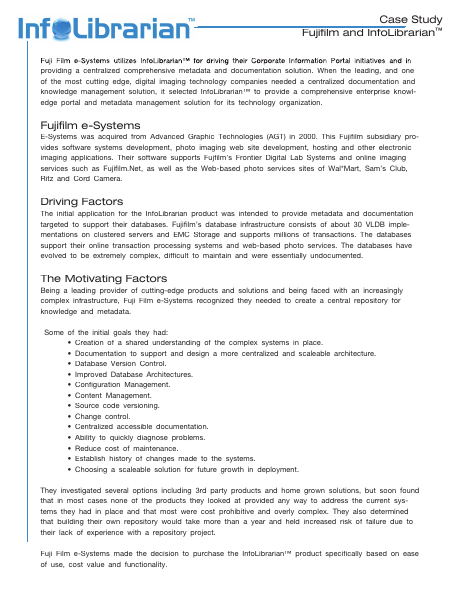
Challenge: Fuji Film e-Systems ran roughly 30 very large databases on clustered servers and EMC storage, carrying millions of transactions behind Fujifilm’s Frontier Digital Lab Systems and the web photo services it operated for major retail chains. The databases had grown extremely complex, were difficult to maintain, and were essentially undocumented. Third-party products were cost prohibitive or could not address the systems already in place, and building a repository in house was estimated at more than a year with real risk of failure.
Solution: InfoLibrarian was selected on ease of use, cost value and functionality. It produced documentation and impact analysis across databases and stored procedures in every environment, then expanded beyond databases to deployed web code, UDL files, custom scripts and registry settings for technical support and web development. Auto-rescanning was configured to run daily at 5 AM as a low-priority task with a seven-day history retention.
Results:
- 95% reduction in change-related problems over three months
- 30+ performance tuning optimizations effected in a single week
- 30,000+ files scanned across 100+ servers in three environments, in two days
- Daily rescan of the full estate completing in 35 minutes
- A redesigned data model in production within three months
- Training time for new staff reduced by an estimated 60%
- Problems that previously took hours resolved in minutes
“It’s like automatic documentation.”
— Georgia McCabe, Senior Vice President and General Manager, Fuji Film e-Systems
“Within days of implementing the InfoLibrarian solution, we began reaping the benefits. As a development company with systems and resources encompassing many platforms and disciplines, we needed a solution that would allow us to see our inter-related components and how they impact each other. The InfoLibrarian tool is a straight-forward tool that accomplished this with minimal training of our users and with minimal time and resources required for its implementation.”
— Ryan Mills, Project Manager, Knowledge Management Initiatives, Fuji Film e-Systems
The Longer Record
More than 47 named enterprise accounts on the long record. Engagements were measured in years, not projects — the spans below are the period each account held an active support contract.
By support period
Additional engagements
A partial record; additional engagements are not listed. Spans denote active support contracts, not licence duration. Where licences were negotiated as worldwide perpetual, they do not expire — end of support is not end of licence.